Wednesday, December 17, 2014

Why clueless people hate Uber's surge pricing

Uber's surge pricing is awesome. It's a well-executed feature that makes the product better.

And yet... tons of people irrationally hate it!

I've decided to analyze what's happening in people's brains that causes them to express such a wrong opinion about surge pricing.


It's actually very simple:

People who hate Uber's surge pricing haven't come to terms with the fact that it's impossible for Uber to charge the normal fare and still get them a ride right now.

That's all there is to it! Think about it...

  • The surge-haters get that nice houses cost more than average houses, because they intuitively understand that there would be no incentive to build nice houses, and no way to get rich and spend your money on a nice house, unless nice houses cost more.

  • The surge-haters get that last-minute flights cost more, because they intuitively understand that the plane has a finite supply of seats, so when it's two days before the flight, the seats have to be either high-priced or sold out.

What the surge-haters *don't* get is that the supply of Uber drivers is also limited. Every bit as limited as nice houses or seats on a flight.

To get inside a surge-hater's head, imagine how you'd feel if you went to the iTunes Music Store and saw a message that surge pricing is in effect for their most popular songs:
You'd be furious!

You'd be right to be furious, because surge pricing in the iTunes Music Store couldn't be anything other than a way for Apple to exploit their customers. We know this because:
  1. If Apple keeps the price at $1.29 for every song download, they have no problem running their servers and supplying enough copies to meet demand for even their most popular songs.

  2. Since the marginal cost of a song download is tiny and independent of its popularity, we can reasonably expect free-market competition to drive down the price of every song in every music store. Surge pricing in iTunes would be evidence that Apple's song-revenue model works differently from an idealized model of free-market capitalism with rational consumers, which is an economist's precise way of saying that Apple is exploiting their customers.
A surge-hater subconsciously thinks that Uber's drivers are like Apple's music servers, and rides are a limitless free-flowing resource like song downloads. So of course they're gonna be furious when Uber "exploits" them by jacking up the price of a ride!


Surge-haters have an iTunes-like mental model of Uber's supply capacity. They never learned Econ 101, and apparently they also never learned from their firsthand experiences hailing snailcabs. They selectively remember that snailcabs have a fixed rate, but selectively forget that it can take an hour to get a snailcab when demand is high.

Imagine you call up Yellow Cab for a ~$20 ride, and they tell you the driver will come in an hour. If you're like most people, you probably think it's worth throwing down an extra $10 to cut your wait time from 60 minutes down to 5 minutes. Guess what? That's surge pricing. This is just a typical, totally average, totally reasonable surge pricing scenario.

The iTunes analogy is a satisfying explanation of how so many surge-haters came to hold their wrong opinions. But I'm convinced that if the surge-haters learned Econ 101, they'd completely reverse their position. Because every surge-hater argument I've ever heard has zero validity.

Surge pricing has a lot of haters, but it's awesome. Thanks for moving us forward, Uber.

Thursday, June 21, 2012

Go to college, or eat unlimited meat?

Think of someone you know who just graduated from college. Chances are, they're still hunting hopelessly for an "entry-level" job. Well, you know what would make their job search a lot easier, and land them a job that's much better than entry-level? Taking four years of their life to build job skills.

It's a shame that most people only begin to build job skills after college. They should have been building job skills instead of going to college. 

College isn't worthless. (You'll learn a few things, make a few friends, and get a piece of paper that will make your entry-level job search a little less hopeless.) College is just a bad way to spend four years of your life.

And that's why I'm introducing the All-Meat Lunch for College Avoiders.

The All-Meat Lunch for College Avoiders

If you are of college age, have been accepted to a state or private college, and do one of the following:
  • Decide not to go college
  • Drop out of college
  • Delay college by at least 1 year
I will take you to lunch at Espetus Churrasceria in San Mateo.

Espetus Churrasceria is a high-end Brazilian BBQ restaurant with great food, atmosphere and service. They have an all-you-can-eat lunch with seven types of steak. So ask yourself, do you want to go to college, or eat unlimited meat?

I am guaranteeing the AMLCA for the first 10 college avoiders to claim it. After that, I might stop because of time and money limitations.

To claim this offer, email me (wiseguy@gmail.com) and start your subject line with "[AMLCA]".

Wednesday, November 23, 2011

3 Reasons to Write Plainly

My friend showed me an essay he wrote for his college application, and I thought it sounded like flowery BS. So this is what I emailed him.

---

You should write more plainly for three reasons:

  1. People have bad reading comprehension. People read things and "get the gist" - but it's a pathetically vague gist.

    (Readers have no idea how bad their understanding is. They'll think they've understood something they've read, but fail to answer a simple test question about it.)

  2. Readers get bored easily. The more bored they get, the more they skim, and the less they understand.

    If you want to be understood, don't wrap your message in a bouquet of flowery words. They won't unwrap it, they'll ignore it.

  3. It's already hard enough to get people to understand your concepts.

    Only a few things are easy for everyone to think about: Concrete statements about people, animals, food, war, sex, morality, personality, games, and landscapes. Almost every other concrete thing, and almost every abstract thing, is hard to think about.

    So when you're writing about easy things like sex, you can say fancy things like "I am the east, and Juliet is the sun."

    And when you're writing about hard things like the theory of relativity, you have to say plain things like "Mass dents spacetime the way a bowling ball would dent a bedsheet."

    Most things you'll write about are like the theory of relativity, and not like sex.
So don't write a hard slab of beef jerky that your readers have to chomp on with all their might.


Process your ideas into Gerber weenies.

Friday, February 25, 2011

You can have as much as you want

You like M&Ms, right? So consider this fascinating state of affairs: You can have as many M&Ms as you want.

The fascinating part isn't that you can have nice things -- it's that for some nice things, you can have as much as you want. You can keep eating M&Ms until you completely extinguish your desire to eat more M&Ms, and eat more M&Ms the instant your hunger is rekindled.

If you want to appreciate the luxury of modern life, forget about how awesome our airplanes and cell phones are. Instead, just focus on all the luxuries that are available and affordable to you in unlimited quantities.

  • You can eat as many calories as you want.
  • You can eat as many different kinds of foods as you want.
  • You can have as many pillows and cushions as you want.
  • You can read as many books as you want.
  • You can watch as many movies as you want.
  • You can watch as much porn as you want.
  • You can listen to as many varieties of music as you want.
  • You can take a shower for as long as you want.
  • You can drink as much of any beverage as you want.
  • You can get as drunk as you want.
  • You can make your house as hot or cold as you want.
  • You can light your house as brightly as you want.
  • You can plug in as many electrical appliances as you want.
  • You can drive to as many places as you want.
  • You can learn as many skills as you want.
  • You can talk with as many different people as you want.
If you want to know what the future will be like, just think of everything you like, and imagine having as much as you want!

Thursday, February 17, 2011

Searle's Chinese Room: Slow Motion Intelligence

Imagine if the only books ever written were children's books. People would think books in general were a joke. I think the situation with computers and algorithms today is similar: people don't understand the ridiculous potential power of an algorithm because they only have experience with the "children's algorithms" that are running on their PC today.

Take John Searle's famous Chinese room thought experiment, which goes like this:
A man who doesn't speak Chinese is alone in a room with a big book of rules. The rule book gives detailed procedures for how to write a response in Chinese to any question written in Chinese.

An interlocutor standing outside the room writes a question in Chinese on a strip of paper and slips it under the door. To the man inside, the paper is full of meaningless squiggles. But by painstakingly following the syntactic rules in the rule book, he is able to put together a string of Chinese characters that reply to the interlocutor in perfect Chinese.

Searle claims it's obvious that nothing in the room has a "real understanding" of Chinese, neither the man nor the book. Therefore Searle concludes that "real understanding" is not something a computer could ever have, since a computer is just a rule-following system like the man and the book in the Chinese room.

Searle's Chinese room is a great thought experiment, but it's ultimately a non-insight. I just don't buy that nothing in the room has a "real understanding" of Chinese. Want to know what really understands Chinese? It's quite simply the "rule book".

You have to realize that the "rule book" is not a "rule children's book". You can be sure it has a lot more pages than any actual book could have. Maybe it doesn't have as many pages as a human has neurons (100 billion), but it could easily be a million-pager like the code for Microsoft Word.

And you can be sure the person in the room would be flipping among the pages of instructions a lot slower then the firing rate of neurons. Considering that brains have billions of neurons all firing up to 100 times each second, we're looking at a trillion-fold speed difference between these two language-processing systems.

If you watched an actual Chinese speaker with their brain slowed by a factor of a trillion, you'd see slow and soulless neuron-level computation. When you compare that to watching a man flipping around in a rule book, the Chinese room doesn't necessarily seem like the more mechanical system.

Both systems get their soul back when you zoom out. Imagine zooming out on the Chinese room enough that you can watch a million book-flipping years pass while the interlocutor is waiting for a yes-or-no answer. If you watch that process on fast-forward, you'll see a chamber full of incredibly complex and inscrutable machinery, which is exactly what a Chinese speaker's head is.

The Chinese room is supposed to persuade you that a system made out of mere pages can't "really understand" language. But it doesn't address why a system made out of mere neurons shouldn't have the same limitation. To me it seems clear that the two systems have similar architectures and possess similar powers of understanding.

Sunday, August 22, 2010

Are You 1 in 1,000,000?

Basically, I want to make some viral thing before I die.

http://areyou1in1000000.com

Saturday, July 10, 2010

Be Impressed

When would you say this to someone?
"Thanks for doing such a great job on this project. I'm happy you're taking on more and more responsibility."
You probably think you'd say this when someone has impressed you with their performance. But what if the person's performance is merely borderline acceptable, and you give some constructive criticism, and yet you still say it? Then you've performed a Jedi mind trick.

To the human subconscious, a statement like that is a powerful command. And I bet you know exactly what I'm talking about, now that I've brought it up: When you tell people they're making a positive impression on you, they automatically turn up the behavior that caused it.

If you want to get more out of the people around you, you need to start the virtuous cycle by noticing when their effect on you is even the slightest bit more positive than usual, and acting pleased.

And if there's someone who never pleases you, maybe part of the reason is that your consistently cold reactions to that person have flattened the reinforcement gradient that would normally amplify their positive behaviors over time.

Be appreciative whenever anyone behaves in what you judge to be the top 20% of their range. And if you want your reaction to cause an even bigger shift in their motivational dynamic, then kick it up a notch: be impressed.

Monday, May 31, 2010

What Is My Purpose?

You've probably asked yourself the question, "What is my purpose?" Most people do, and then they die without ever hearing a satisfying answer. Others latch on to some arbitrary answer and feel like their curiosity has been sated, even though it hasn't really been fed.

It's easy to see that the question can be asked more precisely. You probably want an answer that was determined before you were born, right? By an entity that can be said to have "created" you in some sense? OK, we can work with that.

If you're in the habit of asking such "deep mysterious questions", you'll notice that it usually doesn't make sense to try to answer them as they are posed. Instead, the way to make the mystery go away is to explain what happens in your brain that makes you feel such a question is meaningful to pose.

Your brain generates questions to fill in gaps in your mental model of the world. But sometimes you start with an inaccurate mental model. So when you ask a question that makes sense to you, it doesn't necessarily constitute a meaningful question about the world.

In this case, the inaccurate mental model at fault is the concept of "purpose". Human thoughts are constructed out of building blocks that are hardwired into our brain. Our intuitive ontology includes concepts like "object", "momentum", "mood", and in particular, "purpose".

Our intuitive notion of purpose isn't perfect, as I will explain, but it is tied to meaningful observations. For example, we correctly intuit that a sundial is a lot more "purposeful" than a pile of rocks. That's because, in order to judge "purposefulness", we subconsciously make a distinction about why each thing exists:

  • Pile of rocks: Because of a passive physical process.
  • Sundial: Because of an optimization process.
If you'd never seen a sundial, and one day you saw one standing next to a pile of rocks, right away you'd subconsciously put it in the second category, because it's too improbable to be in the first. The best hypothesis to explain your observation, the one that most accurately predicts the existence and properties of sundials, posits the existence of a process that tries to "optimize toward a time-telling objective".

Even if you'd never heard of a sundial, and you didn't know about the time-telling objective, you would subconsciously assume that there's some criterion the sundial satisfies, and that some "optimization process" out there only creates things that satisfy that criterion. We're programmed, correctly, to conclude there's an optimization process at work when we see something that looks a lot more improbable than a pile of rocks.

When we detect an optimization process at work, we intuitively model it as if it's like a person who is consciously trying to achieve a goal. This works perfectly when the optimization process at work is, in fact, a person, like in the case of the sundial. But our intuition is completely unprepared to reason about an optimization process that isn't human-like.

A prestigious group of philosophers famously fell victim to their flawed intuition about optimization processes, and all their publications became contaminated with the assumption that optimization can only be performed by a purposeful human-like entity. I am talking about everyone before Darwin.

Before Darwin, people's intuitive purpose-o-meter was well-calibrated when it came to sundials and rocks. But the level of optimization evident in life forms registered off the charts, and people intuited that whatever created them must have had one hell of a purpose. The famous "argument from design", believed by everyone from Socrates to modern creationists, goes like this:

  • Boy, life forms sure are optimized to satisfy certain criteria really well.
    [Accurate observation.]
     
  • They couldn't have been made by any old process; it had to be an optimization process.
    [Sound intuitive inference.]
     
  • Life was created by a process involving a purposeful designer.
    [Unsound intuitive inference.]
Before Darwin, everyone knew about the biological processes of variation, reproduction and death. But all those things were filed under the mental category of "passive physical process". Darwin realized that a combination of those passive physical processes leads to Natural Selection. And Natural Selection is a process that only creates things that satisfy the criterion of reproductive fitness. And that means it belongs in the other mental category: "optimization processes".

But human intuition isn't having any of this. Intuitively, "passive physical process" and "optimization process" are two fundamental mental categories, and it's inconceivable that you could build an optimization processes out of a combination of processes that are not themselves optimization processes.

This is one of the most common patterns in the history of scientific progress. Someone will say "Hey, what if Y is made out of this other thing X, even though X by itself is nothing like Y?" And your intuition will say, "Nope, trust me, Y is ontologically fundamental, so no insights here." For example:

  • Your intuition thinks sound is a fundamental thing, and wind is another fundamental thing, but really they are both properties of the movement of air particles.
     
  • Your intuition thinks motion and rest are two fundamentally different things, but really the only difference is your choice of reference frame.
     
  • Your intuition thinks your hand is made out of special organic matter whose mysterious life force makes it obey your mental commands, while a lump of clay is made out of boring regular matter. But really the only difference is that your brain controls muscles in your hand through a big wire.
A related pattern is that when you don't understand some phenomenon, it often feels like a grand irreducible mystery. Most of your ancestors were completely ignorant about science, so your intuition is only expecting to hear stories that "explain" a phenomenon while keeping the mystery intact, and without actually increasing your ability to make predictions about it. The last thing you expect is for the mystery to be explained in terms of non-mysterious concepts. But that's what Darwin did for the origin of life, and the explanation for your "purpose in life" curiosity will follow as a corollary to Darwin's insight.

Remember that any time you observe optimization, like with the sundial, you immediately make a mental model of an optimizer that possesses human-like purpose. You subconsciously observe lots of optimization in yourself and others, so you conclude you were created by a process with a human-like purpose. You want to complete the analogy: "Sundial is to time-telling as I am to ______".

If you fill in the blank with "perpetuating the relative frequency of certain alleles in the gene pool", then the analogy is a logical one. But even with our post-Darwinian understanding, which enables us to complete the analogy, it still doesn't feel like the mysterious question has been adequately explained away.

Why doesn't anyone actually try that hard to perpetuate their genes? People have a lot of sex, but they use birth control. People have kids, but not that many. And why do sperm banks have to pay men, instead of the other way around?

It's because perpetuating your genes isn't your purpose. It's your creator's optimization criterion, but it's not your purpose. You have your own purposes.

If you were creating an entity, and your purpose was to perpetuate its set of genes, and you were going to make that entity conscious, then wouldn't you make your creation consciously want to perpetuate its genes? That's the smart thing to do.

But the process that created you is pretty stupid. It pushes toward genetic fitness, but it doesn't do it perfectly. In fact, there are all kinds of obvious ways to make its creations more fit, but they're only "obvious" to a smart process like your brain. The only changes that are obvious to natural selection are the ones caused by minor mutations to the alleles in the current gene pool.

You are the product of a creator that did an impressive, yet also pathetically bad, job of optimizing you to perpetuate your genes. If Natural Selection were smart, it would have created you with one single, unshakable purpose: to perpetuate your genes. But it didn't. What purposes did it give you instead?

Well, it was trying its best to program a gene perpetuation purpose into the human brain, but it could only do a little bit in each generation. What we ended up with is a variety of impulses, some contradictory, and none of them explicitly representing the desire to perpetuate genes (although the desire to have kids comes close) -- but all of them unknowingly cooperating to get the job done in our ancestors' environment.

Would you trade the many fragments of your purpose -- curiosity, love, empathy, aesthetic taste, sex drive, ambition -- for a single-minded drive to maximize the number of copies of your genes? You wouldn't, because the fragmented purposes are already hardwired into you as precious values.

Your real purposes are represented in the physical structure of your brain, in its haphazardly optimized design. If Natural Selection had been a more effective optimizer, then we would all agree that donating food to charity is even more foolish than throwing it in the trash, because the recipients would perpetuate their genes in competition with yours, without reciprocating the favor of free food. But instead, that action is universally acknowledged as a noble one, and we wouldn't have it any other way.

It's ironic that, not only do we fail to consciously represent our creator's purpose, we also fail to consciously represent a coherent picture of our own fragmented purposes. We typically act like confused servants to a crowd of waxing and waning drives. If you understand this state of affairs, then you can use the full power of conscious thought and achieve your true purposes better than you otherwise would have. You can strive to be a knowledgeable and effective servant to a crowd of waxing and waning drives.

Saturday, May 29, 2010

Surreal Comfort

The BP oil spill is a truly massive disaster. I feel sad and angry about it, but I have to be honest: I don't live on the Gulf Coast, and I'm not affected at all.

Have you ever noticed how the world truly seems to be on the brink of going to shit, but your own life is great? It always seems like the worst is yet to come, like we're pushing our ecosystem and our economic system past some sort of point of no return and it's all just going to spiral into some sort of permanent worldwide collapse.

But in my own life, I live comfortably and do whatever I want, constantly learn cool new things, and buy progressively more awesome wireless-enabled devices with touch screens. Sometimes I wish I were allotted a fair individual portion of suffering after a tragedy like the BP spill. Because carrying on with my daily routine in my beautiful suburb, comfort intact, is surreal.

Friday, May 14, 2010

SadTech Update

In 2005 I wrote that Lines are SadTech. Finally there's a cool startup that is solving the problem: QLess. VCs take note.

Thursday, December 31, 2009

KEO Time Capsule Entry

The KEO satellite project is launching a time capsule into space:
In 2009/2010, all of this [user-submitted] material will be transferred on board the satellite KEO and launched. KEO should return to Earth after circling our planet for several thousands of years, providing the world of tomorrow with an authentic image of what human beings are like today.
Today is the last day for anyone to submit text that will be stored in the digital time capsule. Here is my submission:
On December 31, 2009, the following obviously correct ideas are considered to be on the cutting edge of philosophy:

  • There is no such thing as an afterlife.

  • Many Worlds is the most clear-headed and productive way to interpret quantum mechanics.

  • Reductionism: The belief that the universe isn't fundamentally made out of love or consciousness or life or cells, but rather, that it has some fixed mathematical structure which admits to being modeled using various layers of abstraction on which those concepts can be defined.

  • Nothing -- not the big bang, not consciousness, not life -- is an inherently mysterious phenomenon. The universe is all representable mathematical relationships, and mystery is just a feeling in the mind of an observer.

  • The structure of consciousness and intelligence is cleanly separated from the quantum level by a level of abstraction. The only relevant details about low-level physics that those phenomena exploit are the implementation details of some Turing-equivalent model of computation.

Wednesday, December 16, 2009

Programmer Interview Question

I have a favorite interview question I always ask programmers on a written test or in person (not so much on the phone). I just posted it on the Quixey blog:
Write a function findInSorted(arr, x). It’s supposed to return the smallest index of a value x in an array arr which, as a precondition, must be sorted from least to greatest. Or, if arr doesn’t contain an element equal to x, the function returns -1.
The great thing is, everyone understands it, and everyone thinks they can easily do it. But the answers I get are always non-working, off-by-1, sub-optimal in asymptotic runtime, inelegant, and/or not so good with edge cases. And that is why we're using it to screen programmer applicants at Quixey.

Monday, December 07, 2009

Quixey

Have you noticed the snowballing apps trend? There are hundreds of thousands of apps out there. Desktop software, web apps, apps on social networks, apps on mobile phones, apps on CRMs, Firefox extensions, plugins, desktop widgets, and next year even apps for your car. Each month, the pace accelerates, with more and more platforms and apps getting released.

Yet, when you get into a situation where one of these apps can actually do something helpful for you, suddenly there's a huge market failure. If you need to...

  • Track invoices for a small dental clinic
  • See what iPhone apps will be cool to have on your trip to France
  • Get something to help you to be a better musician
  • Get the best software for helping your kids practice reading
...then, realistically, you're probably not going to do anything. It's just too much of a pain to search Google and wade through various blogs, spam sites, and web pages offering apps that you aren't sure can meet your needs. Think about all the hassles:

  • You can't describe what you want. Go to the iTunes store and search for "be a better musician" or "musicianship". No results! You will have to rack your brain for the right keywords to describe specific app features: "ear training", "scale practice", etc. Shouldn't you be able to just type in what you want?
  • You can't describe your circumstances. Go to Google and search for "apps for dentists" or "going to Paris apps". The results are a mess. If you want to browse the vast multitude of apps, shouldn't you get to see what apps are useful for your profession, your destination... your circumstances?
  • You can't evaluate the best match for your needs. Go to Google and search for "software to teach kids reading". If you're lucky, you'll find a nice listing like "best educational software", and download their recommendations. But why settle for "best educational software" when you want to know what's best for teaching kids to read? Shouldn't you get to see a list of educational software sorted differently depending on whether you search for "teach kids reading" or "teach kids math"?
So: I just left my job at Slide, moved from San Francisco to Sunnyvale, and for the last month I've been working full-time as a co-founder at a small startup called Quixey. Quixey's mission is to enable you to discover apps. We plan to launch an early beta in January. Until then, you can follow the Quixey blog.

Saturday, May 09, 2009

You Are A Brain

Here is a 2-hour slide show I made for college students and teens:

You Are A Brain

It's an introduction to realist thinking, a tour of all the good stuff people don't realize until they include a node for their brain's map in their brain's map. All the concepts come from Eliezer Yudkowsky's posts on Overcoming Bias.

I presented this to my old youth group while staffing one of their events. In addition to the slide show, I had a browser with various optical illusions open in tabs, and I brought in a bunch of lemons and miracle fruit tablets. They had a good time and stayed engaged.

I hope the slides will be of use to others trying to promote the public understanding of rationality.

Note: When you view the presentation in Google Docs, make sure you can see the speaker notes. They capture the gist of what I was saying while I was showing each slide.

Monday, May 04, 2009

Close Friendship

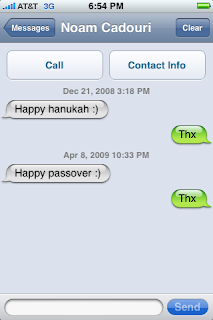
My friend Noam is a really cool guy, but I can't say we've been close.

Sunday, February 01, 2009

Animal Morality

I was happily eating meat one day and I realized that killing sentient things might be the kind of thing society takes in stride but is actually really bad, like slavery used to be. I should do something like a crisis of faith regarding whether or not it's okay.

The question at the heart of the matter is: How do we morally evaluate animal affairs? Here are my intuitions:

1. If you light a cat on fire, that's really bad. If you press a button to instantly vaporize an unsuspecting cow, that's morally neutral. If you step on a snail, no biggie.

2. If you keep a chicken in such a small cage that it can't turn around, that's bad. If you neuter a dog, that's better but still a little bad. If you make sure an un-neutered dog never gets to interact with a bitch (ensuring he can't have sex and puppies), that's morally neutral.

3. If an animal is already dead, the act of eating it is morally neutral. In fact I think the moral neutrality holds even for eating dead humans (although of course that activity will have a different context and there could be all kinds of other negative terms that go into the morality summation).

4. If you pet your dog, that's good because he likes it. (You like it too, which is another positive term in the morality summation. But the dog's enjoyment gets its own terminal value.)

5. If you wirehead an animal, it has the same moral value as any other orgasmium (orgasmium is the simplest configuration of matter which can be sentient and have the subjective experience of happiness, and whatever triggers the happiness sensation is constantly on at full blast). And I think orgasmium's existence is morally neutral.

So when an animal exists, goodness is some function of its happiness that increases while the happiness is within the animal's natural range, and subsequently drops to zero.

The point at which the animal's existence is morally neutral is around "somewhat happy". As you move left from that point, it monotonically decreases without bound. And even while you're within the animal's commonly experienced levels of pain, your trough in the graph is already deeper than the peak is high.

Here is a somewhat counterintuitive application of my tentative animal morality. Imagine there is an Animal Planet which is home to large populations of all the different animals from contemporary Earth in various ecosystems, but with no humans. It would be morally good to instantly vaporize Animal Planet, because putting all the suffering animals out of their misery will surely outweigh the cost of killing the few animals whose happiness is at the top of their natural range (and not higher).

Sunday, October 19, 2008

Are Semicolons Pretentious?

I just realized it's impossible to use a semicolon when you're writing with a casual tone; it comes off as pretentious. Right?

Wednesday, April 30, 2008

Amazon's New Price Font

Maybe this is just me, but it seems like Amazon.com has managed a huge psychological breakthrough with the slightly altered fonts and styles on their product pages.

Somehow it seems like the larger, skinnier red price letters make it really easy to just click and buy, and even disappointing not to do so.

Wednesday, April 16, 2008

Overcoming Bias

Overcoming Bias is my favorite blog. I've always thought of myself as a highly rational person, but after spending about 40 hours reading the series on rationality by Eliezer Yudkowsky, I've realized that the methodology of rationality is a lot more subtle and fascinating than I thought. It's fair to say this blog has changed my life more than anything else I've read in the last year. Here is one great quote among many:
It is a corruption of curiosity to prefer the question to its answer. Yet people seem to get a tremendous emotional kick out of not knowing something. Worse, they think that the mysteriousness of a mysterious phenomena indicates a special quality of the phenomenon itself, inferring that it is surely different-in-kind from phenomena labeled "understood". If we are ignorant about a phenomenon, that is a fact about our state of mind, not a fact about the phenomenon itself.

Sunday, March 30, 2008

On Undefinable Numbers

If you are asked to define the biggest number you can, and restricted to only using only 1000 characters of English text, then there are only finitely many things you can write, and only finitely many numbers you can define.

Out of all the numbers nameable with 1000 characters of English text, which is the biggest? Surely, it must be huge -- a lot bigger than "a googol to the power of (a googol to the power of a googol (...and so on, nested a googol times))".

Unfortunately, there is no such "biggest number", because there is no well-defined mapping from English phrases to numbers. In Who Can Name the Bigger Number, Scott Aaronson considers:

"One plus the biggest whole number nameable with 1,000 characters of English text."

This number takes at least 1,001 characters to name. Yet we’ve just named it with only 80 characters! Like a snake that swallows itself whole, our colossal number dissolves in a tumult of contradiction. What gives?

The paradox I’ve just described was first published by Bertrand Russell, who attributed it to a librarian named G. G. Berry. The Berry Paradox arises not from mathematics, but from the ambiguity inherent in the English language. There’s no surefire way to convert an English phrase into the number it names (or to decide whether it names a number at all).

The problem with English isn’t that it’s unsuitable for a discussion of math. On the contrary, it’s too good at discussing math. The Berry paradox shows that if phrases in a language could all be unambiguously interpreted as numbers, then the language wouldn’t be able to refer to itself with anywhere near as much expressive power as English.

The Berry paradox only applies when one attempts to define big natural numbers using natural language. But there is also a second problem when you try to define a real number using any representation: the finite-length strings you use to represent real numbers aren't able to represent them all.

The problem is that the set of real numbers is uncountably infinite, while the set of finite-length strings is countably infinite. (If you don't know what that means, then read the Infinity lesson notes from X-treme Thinking). Thus, the set of real numbers that you can define is only a countable island in the uncountable ocean of reals.

OK now imagine you're given an infinitely long piece of paper with a real number printed on it. It starts like this: 0.821480865132823066470938446095...

As far as you look, the numbers seem completely random. You don't discern any pattern at all. Let's say you have an eternity to look at this number and try to understand it, but when you're done, you have to communicate which number this is to a mortal living in a finite universe. What do you do?

In the general case, this is impossible, because we know that most real numbers are undefinable. So do you just give up? But wait, the number you were given was actually Pi, except with the first 100 decimal digits taken out. You could have just told that to the mortal!

Every real number has infinitely many decimal digits after the decimal point. And in general, it takes an infinite amount of information to communicate which real number you're talking about. But it would be overkill for me to spend my life trying to say infinitely many 3's as in 0.333333... when I could just use a finite shorthand like "one third" or "zero point three three three and so on". Certain real numbers admit to being identified by finite pieces of information. These numbers include Pi, for example, as well as the number 0.56656565556... whose 2nd, 3rd, 5th, and all other prime-numbered digits after the decimal points are 6's, with the composite-numbered digits all being 5's, and way more elaborate constructions than this.

So what kinds of real numbers can't we define? What does an undefinable real number look like? It looks like a number that you can't say what it looks like. In other words, it looks completely and truly random, more random than it's logically possible for finite creatures to understand.

So not only are we unable to talk about "the biggest whole number nameable with 1,000 characters of English text", we also can't say anything interesting about which real numbers are definable. In other words, the vast majority of real numbers are undefinable, but we can't imagine which ones they are, and we wouldn't know them when we see them!

Does it even make sense for us finite humans to talk about the existence of "undefinable real numbers" and the supposedly "infinite amount of information" that they contain? Are we talking about anything at all? It seems like the "ocean of undefinable reals" is really a make-believe ocean, and the "island of definable reals" is really all that's there to talk about.