Thursday, March 30, 2006

Conversations with God

The new book in the "Conversations with God" series just came out. It's called Home with God : In a Life that Never Ends. I don't know whether this is common knowledge, so I'll just put it out there:

"Conversations with God" is a hoax!

The books read like a dialogue with God. Here is some witty banter between author Neale Donald Walsch, and God:
God: How deep do you wish to go in your higher understandings? Should you choose to continue with this conversation, I will present you with 100 more words -- a 100 Word Formula for All of Life.

NDW: Well, there's a tease.

God: That's exactly what it was meant to be.

NDW: And it worked. I'm not about to cut the conversation short now. So here I am having a conversation with God about living and dying. Again.

God: Yes, but looking at many things that we have never discussed before.

NDW: Who would believe this . . .

God: It doesn't matter. You're not having the conversation for anyone else, you're having it for yourself.

NDW: I have to keep reminding myself of that.

God: So often people see themselves as doing something for someone else when they're really doing it for themselves.
Everybody is doing everything for themselves. When you awaken to this awareness, you will have reached Breakthrough. And when you understand that this is true even about dying, you will never fear dying again. And when you no longer fear dying, you will no longer fear living. You will live your life fully, right up until the very last moment.

NDW: Hold it. Wait a minute. You're saying that when I'm dying, I am doing it for myself?

God: Of course. Who else would you be doing it for?

Unbelievable. I like how the author pretends like he is outside the system, like when he says to God, "So here I am having a conversation with God about living and dying. Again. ... Who would believe this". No one in their right mind would believe this! And God replies that it doesn't matter. But contrary to God, it does matter, because this is currently the #1 selling book on Amazon.com.

I am really disappointed that so many people are into this series. Here are some choice quotes I've seen from a few people who aren't (with my emphasis):

Maddox:
My book is currently ranked #2 on the best seller's list on Amazon.com, push that son of a bitch to #1! I'm currently being beat by a book called "Home with God." Are you shitting me? Pre-order my book for $9.57 now.

Nick Hriciga (Amazon.com reviewer):
To say I expected much from this book would be a lie; I cannot expect much thought in a book so inherently devout in topic. I did, however, expect more than some self-riotous sack conversing with god and assuring me of a heaven. We don't need these books. All they succeeds in doing is agreeing with the bible in every way possible. Way to use faith to blind your consumers. Neale Walsch is a manipulative hack, go out of your way to avoid this garbage.

"Person" (Amazon.com reviewer):
How can you copyright words from God, have all rights reserved for it, and require permission to show it elsewhere?

And here is one ecstatic Amazon review by "Barbara Rose, Ph.D" that is so downright nutty I originally thought it was sarcastic:
It is my deepest belief that anyone who has ever been afraid to die will receive great relief after reading this book.

There is the most love filled tone throughout, of course that unconditionally loving tone and feel comes from GOD.

There is so much reassurance, beauty and truth. Can we "prove" any of this information? Not with scientific data, however, we CAN ask anyone who HAS "died", went to the other side, and came back.

. . .

Thank you, Neale, for your extraordinary contribution to humanity!
This book deserves at minimum 10 stars!

I think the elephant in the room is that you can't have a conversation with God when there is no god. So look at this crap the God character is spouting to get around the dilemma:
God: It is impossible to live or to die without God, but it is not impossible to think that you are.

If you think that you are living or dying without God, you will experience that you are.

You may have this experience as long as you wish. You may end this experience whenever you choose.

OK, God, if that is your real name. I choose to end the experience... NOW. [I pause from typing, waiting for the experience of living without God to end.]

Nope, the experience is still going on. This experience is called sanity, and for most people it is not as simple to end as making a choice. But a lot of people have the handicap of a lifelong indoctrination that began in childhood. And as one reviewer pointed out, Mr. Walsch is taking advantage of their faith to sell bullshit books.

Wednesday, March 29, 2006

Blogroll

I haven't posted much recently, mostly because my thoughts aren't very original. In a typical day, how many of your thoughts are worth sharing with strangers online?

So today here is a link to my blogroll, the stuff I like to read online. You can visit these sites while you wait for new content on Logic and Reason.

Zug - Funny articles. I like John Hargrave's sense of humor.

Marshall Brain's Blog - My favorite author's blog

Dilbert Blog - Scott Adams' blog. Unique take on life.

Critical Section - Ole Eichorn's blog. Interesting in general.

Homestar Runner - A funny website. HomestarRunner is classic.

IWillTeachYouToBeRich - Learning how to be rich.

Maddox's site - He's funny too.

Reddit - A site that aggregates the top coolest things to read online each day. A lot of posts I make on this blog are inspired by articles I read on Reddit.

By the way, I am currently on Spring break, working on RelationCraft and reading Darwin's Dangerous Idea. Wow, look at those awesome reviews for DDI. How can I not read it?

Tuesday, March 21, 2006

Friday, March 17, 2006

Marriage is Unnatural

This Economist article explains that women have a natural tendency to enter into a long-term relationship with a "reliable" man, and then cheat on him with a "dominant" man during the part of the menstrual cycle when she is ovulating.

Wednesday, March 08, 2006

Funny

This recording by John Hargrave of Zug.com is hilarious.

Monday, March 06, 2006

RelationCraft

I haven't blogged for a week because I've been working hard on RelationCraft, my website.

RelationCraft is a new type of social networking site for college students that is focused on relationships. The name can mean that you go on the site to craft your relationships, and it is also a bit of a pun (RelationCraft instead of Relationship -- a ship is a type of craft).

Here is a timeline of the site's progress:

October-November: Brainstorming. The general idea occurred to me in October, and for a month and a half I was compiling a big Word document of ideas.

December: Designing. I consolidated the brainstorm down to a list of ideas to implement in the initial release of the site, then I filled up about a dozen sheets of paper with sketches of the site layout.

January: Learning. I started off with a good general knowledge about HTML and HTTP, but I had never done any web programming before. I decided to use ASP.NET for the site because I already have experience with Microsoft .NET and I think it is an awesome development environment. The IDE of Visual Studio 2005 is the smartest in human history.

     The experience was frustrating at first. It is a fascinating paradigm shift to be using the same kind of high-level programming language for a web application as for a Windows application. But because this web application is so complex, there were a lot of minor details about the way ASP.NET works that I had to get used to. I wasted many hours on relatively trivial problems because I only had one friend who knew more about this than I did.

February: Programming. After a slow start, I finally got the hang of ASP.NET, and I was amazed that some of the more complex implementation ideas I was dreaming of (asynchronous server interaction through HTML frames) were realistic. ASP.NET is a truly powerful rapid development solution. So I registered the domain name RelationCraft.com and signed up for hosting with GoDaddy. (Unfortunately, because the site is for college students only, it enforces the registration requirement that you must have an email address from an approved college. I'll post information about demoing the site in the future.)

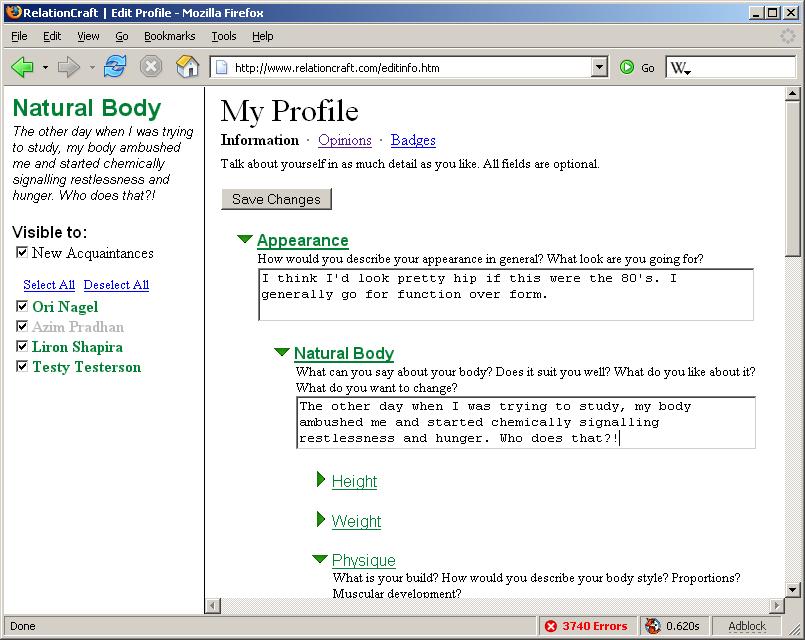
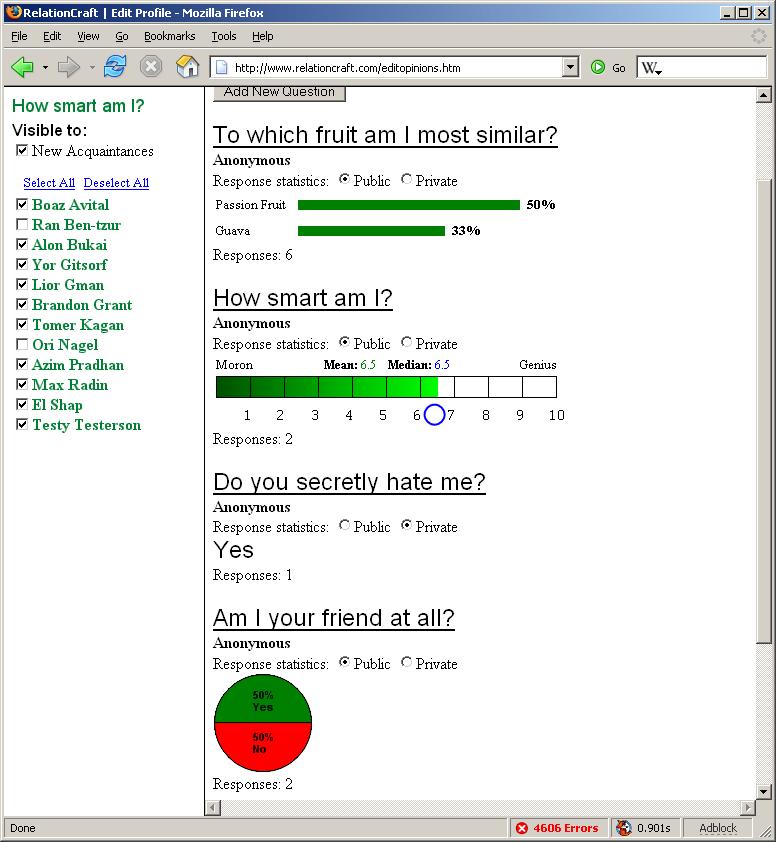
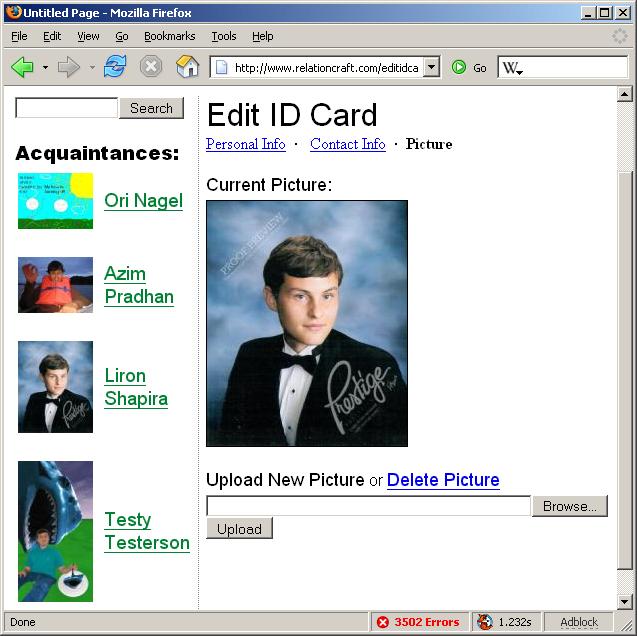
March: Well, I'm still programming, but I am a few days away from having a polished demo site with a few initial features. I realize I haven't actually described any innovative ideas from the site yet, and I don't really feel like typing them up right now, so just check out some preliminary screenshots.


Tuesday, February 28, 2006

Not Reading Books

Remember when I posted that Marshall Brain is my favorite author? So I realized I've never read a single Marshall Brain work on paper. I've probably read the equivalent of over a thousand book pages, all online.

I haven't read an actual book for leisure in a while. I went to the library the other day and got one. I'll post when I read it.

Saturday, February 25, 2006

It's Just in Your Mind

Technically this funny page is safe for work, but it's certainly awkward. It's just in your mind.

Friday, February 24, 2006

Too Lazy to Help Darfur

Man, can you believe in Darfur there is an actual genocide? This is Holocaust-grade stuff.

Click here.

So far I haven't done anything to help out. Have you? Probably not. We haven't been acting very morally, you and I. Those kids who are suffering are human beings just like us. I think it really is the duty of the American people to get the government to take action.

Here is one thing I could do to help people in Darfur that I am probably not going to do:
  1. Get a random job on campus for two weeks and donate all the money I earn toward helping humanitarian organizations defend their aid delivery lines against Janjaweed ambush.
There should be something that people like me can do in a matter of minutes, because otherwise we won't do anything at all, and a few minutes is better than nothing, especially if a lot of people do it.

Freakonomics Fruit

I read Freakonomics last year. It's a good book. This is what the cover looks like:


I always thought fruit on the cover must be pretty tasty. It has all the delicious sour juiciness of an orange in a Granny Smith apple's skin. Yes, it looked so tasty I thought I'd eat one myself:


To hell with genetic engineering. This is the kind of hybrid cross I want to see at the grocery store.

Monday, February 20, 2006

Ordinary Video in 3D

Normally when you watch a video, you perceive the flatness of the screen because your brain compares the image it sees from each eye and realizes that the objects on the screen are not solid. But try this:
  1. Position yourself so that the video screen fills most of your field of vision and watch a segment where the camera angle is moving around.
  2. Close one eye.
The illusion is very convincing because you eliminate almost all the cues that your eye is looking at a flat surface. Note that following these procedures will also make you one-eye high.

Friday, February 17, 2006

Inspirational

You know how over a billion people don't have electricity or even clean water? Obviously this is not an easy problem to solve because it takes a lot of engineering infrastructure, and the political infrastructure doesn't exist to make that possible.

But this article makes it sound like Dean Kamen, the Segway guy, might really revolutionize things. From the article:
Instead of putting up a 500-megawatt power plant in a developing country, he argues, it would be much better to place 500,000 one-kilowatt power plants in villages all over the place, because then you would create 500,000 entrepreneurs.
Good stuff. It's an inspiration to Mr. Kamen turn his entrepeneurial efforts toward making the world a better place.

Thursday, February 09, 2006

Super Saver Shipping

When you go to Amazon.com and make a purchase that totals $25 or more, you get free shipping. This is a pretty brilliant scheme. I know that whenever I shop on Amazon, I always feel like I'm missing out on savings if I buy something under $25.

But another, more subtle aspect is that Amazon sell a bunch of stuff for just a few bucks under $25. So since shipping normally costs almost $6, you're going to want to get your order up to $25. But then all the products that sell for only a few bucks don't qualify for Super Saver Shipping! So it's an incentive to spend significantly more than you otherwise would.

Recently I had an order that came to $23.99. So I searched for a while around Amazon for the cheapest item that qualified for Super Saver Shipping. I finally found it: FastCap Glu-Bot Yorker Tips, 5 pack. They had it marked down from $1.50 to $0.99, so I actually had to buy two. But with the savings on shipping, it was still a logical decision.

Think about what a ridiculous effect of consumerism it is that I'm receiving two packages of Glu-Bot Yorker Tips, whatever the hell those are, because I took advantage of the system. Not only that, but Amazon has actually ended up putting these in a separate shipment! A carrier service is being paid to carry a package with two sets of five useless Glu-widgets to my address, a package which I will promptly throw away without opening. Instead of me paying Amazon for one shipment, Amazon is eating the cost of two shipments. And there is also the environmental cost of all the steps in the process of getting a useless product from the factory to my trash can.

So having discovered Glu-Bot Yorker Tips, it changes the game of shopping for small orders on Amazon.com. Now you can expect to grab at least a little overall discount if your main order is as low as $20.

Wednesday, February 08, 2006

Fractals

Fractals are images that have repeating elements at any scale -- their resolution is infinite. I had an assignment in CS class to make a computer program to generate a fractal by looping through each pixel and determining the color. Here is one of the fractals my program created:


The program renders grayscale pixels whose brightness is determined by a series of mathematical operations. It works like this:

  1. Each pixel represents a number in the complex plane. The real component ranges from -1 to 1, and the imaginary component ranges from -i to i. The center of the image is the origin, which represents 0 + 0i, or just 0.

  2. The program is given the function F(z) = z^4 - 1. The roots of this function are 1, -1, i, and -i, but the program doesn't know this. For each pixel, the program uses Newton's method to calculate one of the roots of the function given an initial guess z0 that corresponds to the pixel's location in the complex plane.

  3. Newton's method figures out roots of a function by generating a series of guesses, each one dependent on the last, and usually the guesses tend toward one of the function's roots. The program is satisfied that Newton's method has found a root of F(z) when the function of the k'th guess, F(zk), is between -0.00001 and 0.00001.

  4. The program then looks at the value of k -- the amount of successive guesses it took Newton's method to arrive at one of the function's four roots. The fewer guesses it took, the brighter it renders the current pixel. Thus, a pixel's brightness measures efficiency with which Newton's method finds a root of F with the starting guess being at that pixel's location.

  5. But if a pixel is located near to one of the four roots, it should be easier for Newton's method to refine a guess starting from that pixel's location. So each pixel is multiplied by a constant that darkens it in proportion to how close it is to any one of the four corners. Notice the dark spots in each of the four compass directions -- those are the locations of the roots.

Now assuming you roughly understand the process by which this fractal was generated, imagine trying to visualize the image in your head without having seen the computer generated image. You couldn't. So as a result, you wouldn't be able to get some insights about, for example, the efficiency of Newton's method at various locations.

Aren't fractals and computers great?

Monday, February 06, 2006

Double Clicks

A lot of inexperienced computer users can't tell when to single click and when to double click, so they just develop a habit of double clicking on everything. Microsoft has compensated for this in many areas of the UI. For example, double clicking on the Start button or any taskbar button only toggles its state once (except in the classic UI).

I was testing my new website (more on that later this week), and I discovered that IE also compensates for double clicks on web form buttons. It only executes the button's JavaScript code as if it were clicked once, even though it graphically shows the button being depressed twice. This may also be to prevent things like double form submits.

Sunday, February 05, 2006

Atheist Catchphrase

Tell me your definition of God, and I'll tell you whether it's wrong or meaningless.

Thursday, January 26, 2006

Not supporting the troops

Joel Stein writes in an LA Times column, I don't support our troops. Makes sense. Check it out.

Monday, January 23, 2006

Time Experiment

My time survey suggests that most people keep really close tabs on the time. I probably check it dozens of times each day. So I was thinking:

What would it be like to go an entire day without checking the time?

Don't set your alarm clock, wake up whenever you wake up, and go the whole day without looking at a timekeeping device. I think you should be able to look outside, because otherwise it just becomes unrealistic. But what would such a day be like?

If you're like most people, you probably can't make it a school or work day. Precise reminders of the time would be unavoidable. But it would be interesting to try to live like that on a Saturday.

Also, when would you go to sleep? Maybe it would be a lot earlier or later than normal. I will attempt the experiment on this upcoming weekend and post the results, so don't leave your computer.

Time Survey


Do not look at a clock until you answer this question:
What time is it? Try to guess it down to the minute.

Check your answer. How far off were you? It's extremely rare to be off by two hours or more. No doubt the vast majority of American adults can pinpoint it to within an hour.

What do you suppose is the median amount of minutes by which people are off? My guess is 5 to 10 minutes.

I conducted an informal survey by IMing the 19 people from my AIM buddy list who were at their computers during the interval of 9:50pm - 10:05pm PST (mostly teenagers). Here are their responses (number of minutes after (+) or before (-) the actual time when they responded), as well as comments they subsequently IMed.

Response: Comments:
-5 lol
-1 well i saw it was 9:59 a when i came back to the computer [6 minutes ago]
-1 i just knew cuz 24 just ended
-2 my nigga
+1 shit, it's 9:52
+6  
-6  
+2 10 minutes earlier i was looking at my watch.
0 lol i looked at a clock a few mins ago, just woke up from a nap
-1 dude, i actually did it for real, i didnt look
0 i looked moments before reading your message because i have to get my laundry
-7  
-3 close
0 holy shit, I swear I didn't look at a clock. i just remember it was around 9:47 a few [9] minutes ago when I called someone
+15 so what are u trying figure out
+2  
0 i was right
-25 oops. oh well.
Liron wtf  

Absolute deviation from the actual time:
Mean: 4.3 minutes
Median: 2 minutes

Wow, so the average teenager at their computer is going to be off by just a couple minutes -- somewhat more accurate than I expected. Maybe a bit too accurate... see the time experiment.

Signed deviation from the actual time:
Mean: -1.4 minutes
Median: -0.5 minutes

The signed deviation from the actual time is different from the statistic I set out to get -- it detects whether the entire population has a tendency to guess the time early or late. The numbers I got have no statistical significance, but it would be interesting to take a sample of thousands of responses nationwide and compare them to standard time to see if the nation is running early or late at all.

Sunday, January 22, 2006

Friendly Close

Pasting in parts of AIM conversations, or "AIM-blogging", should be a whole new genre of blogging. Here is an AIM-blog entry about AIM.